Thursday, May 19, 2011

Bad Places to Faint in Bolivia

A fluffy creature from the Diablada
February and March mark carnaval time in different corners of South America.  My research led me to two different carnavals that, I felt, were necessary to check out.  One was the world renowned celebration in Rio, a sort of Mardis Gras on steroids.   The other was the carnaval held in Oruro, Bolivia.  Perhaps it is just me, but I’d never heard of Bolivia’s celebration, whereas Brazil’s brought to mind iconic pictures of exposed women in magnificent costumes.  When one thinks of Brazil’s carnaval they think of the sparkly masks, the gaudy jewelry, the peacock style costumes, the floats, and the nonstop party.  But what about Bolivia? 
It’s the poorest country in Latin America and I’d been warned by every backpacker I’d talked to that it was a difficult place to travel.  Even Lonely Planet warns of children in ski masks who spit on you and, while you stand there shocked, steal your wallet or slash open your bag.  I’d like to state that the only problem I had with kids on the street was the occasional water balloon being thrown in my direction.  Having said that, a German girl I talked to said that she was a victim of spit robbery.  Maybe I just don’t look like I have anything worth stealing, but I found the people to be warm, friendly, and full of life.  It was, after all, a time of celebration.
You cross the border from Peru and you instantly notice the change.  The houses aren’t as well kept up, the fields aren’t as green, and the people begging for money seem a bit more desperate.   In La Paz and Oruro I was struck by how barren the whole landscape seemed.  My first connection when I hear Bolivia is jungle, but in the highland regions it’s beautiful, but desolate; what I imagine Afghanistan to be like.  My second preconception of Bolivia did turn out to be accurate.  The percentage of native peoples in Bolivia is something like sixty to seventy percent, much higher than other Latin American countries.  The streets were full of women in bowler hats and ornate black dresses.  Full of old men with dark tan faces that wrinkle like accidentally laundered paper when they smile.
This year marked the two hundred year anniversary of the carnaval in Oruro and everything was on a grander scale than usual.  Oruro is a mining town and doesn’t usually have too much activity, but during carnaval it takes a completely different form.  The hotels and hostels had been completely booked  weeks in advance and by Friday evening all the bleacher seats to watch the parade were sold out.   On Friday, the streets were packed with venders and celebrants.  Alcohol flowed freely in every direction and spontaneous marches and horn playing were commonplace.  Kids and adults alike carried large squirt guns, water balloons, and funny foam to spray at passersby.  Many people were wearing ponchos to protect themselves, not from the natural elements, but from each other.
My wife and I had been travelling pretty hard core for a few months before the carnaval.  Plenty of twenty four hour buses and sleepless nights in strange hostels.  The carnaval was to be our last big celebration before we settled down in Santiago, Chile for awhile.  So, while exhausted, we gave the celebration everything we had.  By seven in the morning we were in our seats, beers in hand, watching the police chase passed out drunks off of the parade route.  One man, who was completely incapacitated, was picked up and laid on a bleacher.  He had wet himself and lost a shoe, when he woke up a few hours later in midst of the parade it was as if he’d awoken inside of a nightmare. 
The parade was one of the most amazing things I’ve seen while travelling.  Two days of virtually nonstop brass bands and strange costumed dances.  Two of the dances that have imprinted themselves on my mind are la Morenada and la Diablada.  Morenada is a dance that was made to represent the release of the black slaves.  It’s a strange dance consisting of bearded men with whips, who are meant to represent Spaniards, silvery men in large costumes that look like a layered cake, and beautiful twirling girls in short skirts.  One can identify the Morenada from afar by listening for the spinning noisemakers that the silver men carry that are meant to sound like the clanking of chains around their feet.
La Diablada is a dark affair that deals with archangels, in this case carrying swords and whistles, leading demons and other devilish creatures back to hell.  The dark host of characters consists of fat furry creatures with bug eyes, sexy horned women, and demons with enormous fiery helmets that were so large some had to take them off for short breaks during the parade.  Whenever they took off the helmets it revealed a sweaty and suffering human beneath the horrible mask.  Usually someone would run over and offer the poor soul a large sip of beer. 
The parade and revelry went on for days.  A clear thought, let alone sleep, were unmanageable during the festivities.  I could barely even walk on the streets they were so crowded and whenever I did, for a snack or a toilet break, I always came back covered in white foam.  There was no easy way to and from our seats in the bleachers, my wife and I had to climb up and down rickety ladders made from scrap wood and then push aggressively to get to our seats.  We only left our seats when absolutely necessary.  On Sunday my wife collapsed.  Perhaps it was all the travelling beforehand, perhaps the lack of sleep, perhaps the noise, perhaps the drinking, perhaps the devilish costumes, but she suddenly was out cold.
It was one of the most terrifying moments of my life.  We were in the stands cheering and singing along to the different chants when she fainted.  I didn’t know what was happening at first and started slapping her face.  I started trying to think how I could possibly carry her down the ladder and how impossible it would be to get an ambulance there if this was serious.  Luckily, after a few minutes and a few splashes of water she came to.  I held her hand tight and we pushed our way through the masked, cheering, half insane revelers and made it into our room.  Even behind closed doors there was no escape from the blaring horns and drunken screaming. 
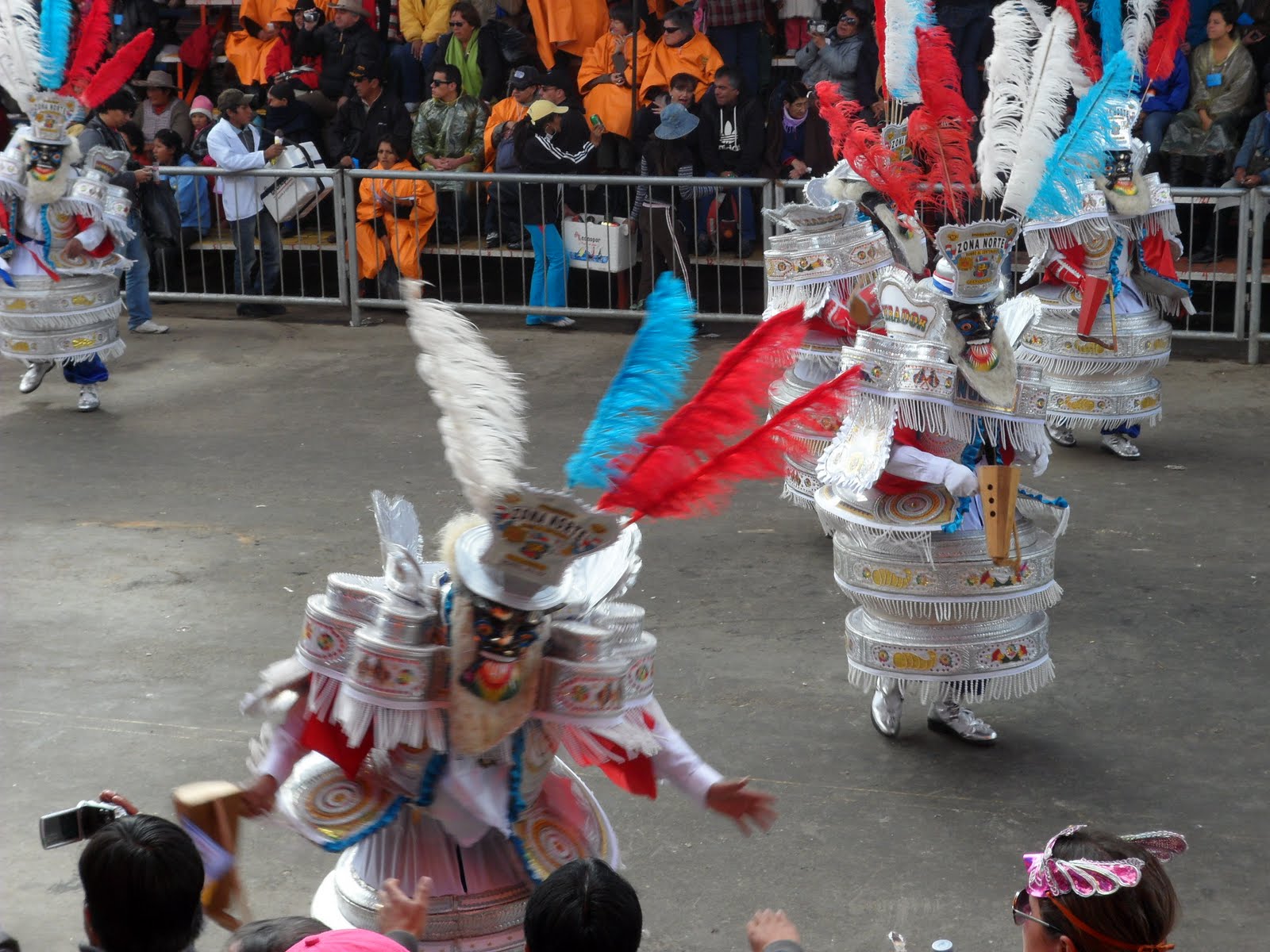
The Morenada

It felt like fleeing from a horror film when we got on the next bus out of there.  I breathed a sigh of relief as the sign said we were leaving Oruro.  If I close my eyes and think back I can still hear the horns and the chanting; my hands get clammy and I feel a bit panicky.  It was just the way a good party should be: just the right mix of insanity, terror, and intoxication so that I’ll never forget it, even if I want to.


Sunday, May 8, 2011

Classy Buskers


Opera buskers
I take my seat between a casually dressed businessman and a strung out looking young woman drinking wine out of a paper cup.  The three opera singers finish a number and are greeted with a warm applause from the audience, even the young woman next to me puts down her wine in order to clap.  I’m not in a concert hall, I’m enjoying lunch and some classically trained musicians who are singing for change on the street.  As the trio begins to sing “Ave Maria” I think to myself, man, these are some classy buskers.

The group I just mentioned is exceptionally talented, but not exactly unique in the city of Santiago, Chile.  Walking in most barrios I’ve seen street musicians singing classical numbers, playing violins, or, in one case, playing a harp—a harp!  Now, in the interest of full disclosure, the man playing the harp was wearing torn clothing and he had a rather scruffy beard, kind of like a fallen angel, but he definitely knew how to play. 

Violin busker in the metro

It’s not just classical music that one hears street musicians creating in Santiago, there are also musicians playing rock, jazz, and more traditional Chilean music, but the ratio of classical music seems unusually high.  Why so classy?  Do people in Chile have more of a proclivity for classical music than in other countries?  Do people part with their change more easily to the sound of Mozart than Bob Dylan?  Is it difficult to get a permit to perform anything but classical music on the street?
Having had difficulty getting in touch with the proper authorities to answer the last question, this writer would like to offer up examples that put the permit theory in reasonable doubt.  Along with the classy buskers previously described, there is another art form, which is quite common in Santiago.  I’d like to term it crosswalk hustling.  In my hometown of Chicago, you might stop your car and have a bum try and wash your windows with a filthy rag in hopes of some spare change.  In Santiago, however, it’s a very different game.  There’s a red light and suddenly a performer, or group of performers, will go out in the middle of the street and do their thing.
I’ve seen people doing strange ball catches and juggling, a one man band who spins around in circles as he loudly plays a number of instruments, and one time, I even saw a group of people make a human pyramid while the captive audience watched (n this case, literally captive as they were waiting for the light to change).  Either during, or directly following the performance, the artist will go from car to car trying to get a little money for their show.  Remember, this whole ordeal takes place in the time it takes for the light to change.  There’s no way that the city is formally allowing these people to perform.  They just get their act together and do a little hustle.
Busker playing the harp
During my university days I’d often considered trying to do some sort of street performance in order to make a little extra cash.  I had a trumpet on which I could play “Three Blind Mice” or I could always try and read some poetry aloud.  Feeling that neither of these would yield much profit from the college community, I instead donated plasma for beer money.  These days, I’m facing a similar crossroads, I need a little extra cash.  I’ve considered breaking out the harmonica or trying to do some sort of performance art project.  From the looks of the competition though, I’m gonna have to class it up a bit.

Sunday, May 1, 2011

The Vagabond's Wallet


world currencies I found in my suitcase


I sit down at the table and assess the situation:  a plate of rice and beans (third time in two days), open the wallet to find it the home of nothing more than lint and a three year old condom.  Three months ago I had been doing the same job for a very similar company.  I’d gone out to eat for nearly every meal, partied hard, and even after a long night out, would often wake up and smile at how much money remained in my wallet.  So again, what happened?  I moved countries.
In the past four years I have been country hopping.  I work, like many other transients, as an English teacher.  What has surprised me more than anything is how dramatically my place in society shifts from year to year.  My first gig was in Vietnam where I instantly felt like a rich man.  I wasn’t really saving money, nor could I.  The currency of the Vietnamese dong was about sixteen thousand to the U.S. dollar at that time.  That said, sixteen thousand dong can get you quite a lot in Ho Chi Minh City.  With the wages I was making, I felt like a king.  Having moved from the states, it was as if I’d suddenly jumped from lower class to upper middle class…at times this made me feel guilty.
After that came Japan; what a kick in the nuts that had been.  The money I’d scrimped and saved to bring with me from Vietnam didn’t amount to much and there was a point before receiving my first paycheck that my wife and I were living off of condiment soup (it wasn’t quite as bad as it sounds).  That said, you get paid a decent amount and I found myself feeling like I fit in a lower middle class income bracket, but without any of the worries that many have (e.g. house, car, children’s education).  Basically, I’d live like a king for two weeks going out and living it up and then spent the next two weeks poor, reading books in my apartment.
The third move was to Korea, which was an amazing place to save money, but I found myself feeling like a slave.  I love the country but it was literally six months before I saw much of the outside of a classroom.  I literally have no idea where to place myself in this society, perhaps, no one really does.  You walk down the street and see seventy five year old hunchbacked women collecting cans that they can turn in for money right next to a department store that sells handbags for three thousand USD.  It’s poverty and decadence living hand in hand.  So, I found that I could spend as much or as little as I wanted, but I never felt myself wanting for anything.  It was more working hours than I could deal with and more money than I could spend.
Now, facing this plate of beans and rice I am struggling to find my place in society once again.  I haven’t been in Santiago, Chile long enough to really place myself in terms of class but I can say that compared to what I was making in Korea, the wages here are laughable.  In terms of lifestyle, I’ve noticed myself doing a lot more cooking, drinking the cheap beer, being careful with how much money I bring with me on a night out.  I’m a baby in this country and still getting myself set up, but I can’t imagine myself ever feeling rich here. 
In the past four months, I’ve managed to travel in three continents and the currency value has changed so dramatically that the bills in your hand begin to seem ridiculous.  A pound, a dollar, a boliviano, a Peruvian Peso, a Dong… they really are just pieces of paper and even when you calculate their relative value to each other, it means nothing.  To try and make sense of what a lifestyle might be in another country my friend and I had a system of calculating the cost of living via the cost of a pint at a bar.  You might be able to come up with a better system, but it all boils down to haves and have nots on different hierarchical levels.  In each country there are rich and poor people, globally there are rich and poor countries.  I guess what I’m waiting to see is where Chile will place me; will I thrive or face stockpiling rice and other dried goods.  Can I afford the beer at a bar.

Saturday, April 23, 2011

A Golden Age of Graffiti


It’s a lofty title, I know, but let me try and explain myself.  I chose my neighborhood, almost exclusively, because it had the best graffiti.  When wandering around looking for apartments, my wife and I found ourselves in Bellas Artes.  It’s like another world, or at least like another wing of a museum (imagine walking from the ice age exhibit with wooly mammoths and then taking a turn and seeing suits of armor… is this metaphor working for you?).  The big slap in the face is the vibrant neon coloring of the majority of the buildings, the large increase in the number of bars and clubs per capita, and some amazing graffiti.
It was a Sunday when we toured the area, so we didn’t get the chance to take advantage of the bars that afternoon.  Instead we admired the bug eyed monsters and beautiful scenes spray-painted on the shutters.  Most of street art is surreal in nature, often dark and cartoony, but there are some done with undeniable precision and realism.  It’s like the whole neighborhood went on an acid trip and woke up to a new décor. 
Whenever I walk around in this neighborhood, I have this distinct sense that I’m living in the early 90’s.  It’s not just the neon colors or the mullets (yes, many people are walking these streets with mullets but that’s a different issue), it’s the innocence of the graffiti.  Sure it’s strange, but it’s in no way offensive.  It’s fun and playful, like the early days of popular rap with Run DMC or Jazzy Jeff and the Fresh Prince (please don’t judge).  The kind of rap you’d let your parents listen to.
Maybe it’s just my poor Spanish skill, but I didn’t find as many obscenities sprayed on the wall as in the United States.  The intention of the artist seems innocent expression and beautification.  Often, I even find old people admiring the walls, not shaking their heads and complaining about the youth of today, but smiling and appreciating.  I myself usually feel inspired and, sometimes, jealous.
I don’t know if the street art is commissioned or what, but the artists are far from secretive about their projects.  Even if it’s a solo project, people are stopping by and giving the artist snacks and refreshments.  The only thing the police do is pat the artist on the back.  The source of my jealousy is this; most places I’ve lived, I couldn’t even paint the inside of my apartment a different color, never mind try spray-painting the building.  Yet these free spirited bohemians seem to get to do whatever they want with, and while drinking free beer none the less! 
I don’t mean to give the impression that artists are free to repaint the city in any way they desire, I don’t mean to say that there aren’t still little scamps tagging the statues of historical figures, I don’t mean to say that there isn’t the occasional offensive phrase scribbled outside an abandoned factory.  What I mean is that, in Bellas Artes at least, many of the buildings have become tapestries and that no one seems to mind.  If you give people the freedom to do be as artistic as they want, sometimes it turns out pretty cool.

Saturday, April 16, 2011

Stray Dogs

There sure are a lot of dogs here in Santiago.  Strays?  That’s a good question.  They don’t wear collars and seem to roam wherever they like without any restraint, but they are amazingly well kempt.  I’m not saying they’re salon fresh with a perm or anything like that, what I’m saying is that they aren’t disgusting.  Their ribs aren’t poking out and their coats aren’t filthy; were you to pet them you’d wash your hands before eating but you wouldn’t be grossed out.
I draw attention to this fact for a few reasons.  One is to point out how different this is from other cities I’ve travelled in South America.  Most places I’ve travelled have their fair share of strays but they look like strays.  I wouldn’t touch those poor dogs in Bolivia with the butt of an umbrella…mangy.  So, does the condition of strays point out some socioeconomic differences in the countries in South America?  Of the four countries I’ve travelled, I’d rank the condition of the strays in the following way (from worst to best condition):  Bolivia, Peru, Argentina, Chile.  It may seem obvious, but the difference is striking.
Also, strays are friendlier here.  The only dogs that have barked at me or tried to nip at my heels while I run in the park have owners, people who keep them on leashes and pat them on the head for keeping them safe.  These owned dogs feel it is their duty to chase anyone who comes close to their keeper (a.k.a. food vending machines).  The strays, on the other hand, seem free from these duties and are generally found sleeping in sunny spots on the street or in the park.  They may perk up if it seems like you have food or are going to step on them, but otherwise they seem oblivious to their human counterparts.
It is this kind of freedom that has led me to start, what I feel are, some genuine friendships with a few of the strays here.  Friendship may be too strong a term so let’s call it genuine friendliness.  When I was in Buenos Aires I remember one little mutt that my friend Hadley and I called “el perro mayor”, who didn’t seem like he had many years left in him.  After watching him get into a pretty nasty fight with a few larger dogs we took pity on him and patted the matted fur atop his little gray head.  He followed us home and we thought, how cute, let’s give him some food.  When we came down the steps with some salami and bread he wasn’t there.  We hunted him down where he lay in the midst of a group of drummers and tried to give him the food.  He looked at the bread with disgust, took the salami, and left us.  No recognition of friendship, no nod of thanks.  I felt cheap.
Here in Santiago there have been numerous dogs who recognize me and there have been no exchanges of food for these courtesies.  There’s the big German shepherd who is old and weary; hanging out in the Bellas Artes neighborhood.  I saw a business man step on him and offered him a place to sit next to my patio table.  He was grateful and put his head on my lap.  There’s the weird jackal looking dog that resides in the mountain park in Santa Lucia.  She always follows me about and has even led me to beautiful views.  I’ve gone to this park several times and she always comes up to me looking to be pet—no food involved.  There are others, my dog friends. 
To summarize my findings, apparently, the richer the country, the better shape their stray dogs seem to be in.  It isn’t quite that simple and there are, I’m sure, exceptions.  It should be the same with the treatment of the poor but then I think of the United States…Secondly, the more freedom dogs have the friendlier they are.  They aren’t confused by their place in a human hierarchy, desperately struggling to fit in by attacking people outside their immediate group.    The exceptions to this rule are the stuck up dogs in Buenos Aires who poop all over the streets and are snooty about their food.  You can draw your own conclusions from that.

My Landlord

When my wife and I arrived in Santiago, Chile we hit the ground running.  Literally running—well, walking quickly—down the streets on a Saturday toting everything we owned around with us as we looked for a hostel with openings.  That Saturday we were smelly and tired from a twenty four hour bus ride and sick to death of travelling after three months of homelessness.  We’d gone from Korea to Vietnam, from Vietnam to Britain, from Britain to Argentina, from Argentina to Peru, from Peru to Bolivia, and finally after a few more stops we were in our new home, Santiago, Chile.  We didn’t really have the time or money to move slowly and get used to the city, so after a good sleep we started apartment hunting the following day.
After exploring a number of neighborhoods, we found the place where we wanted to live.  It was an apartment in Bellas Artes, above a convenience store, and with enormous windows.  The bedroom juts out in a circular fashion giving it the appearance of a commercial property or, if you prefer, like the bridge of a starship.  When we called the number on the sign we had little hope of getting in touch with the landlord.  It was, after all, a Sunday and in Santiago everything seems to close on a Sunday.  According to Jose Miguel, our new landlord, “tiene suelta, muchas sueltas” meaning extremely lucky, to get a hold of him.  Apparently, he lives very far away but as he was visiting his girlfriend only a few blocks away, he was thrilled to show us the place.
He took our great timing as a sign from God.  In fact he went so far as to say that, “God has put you in my path.  You are my responsibility.”  It’s probably just coincidence but I had recently watched a horrible Heath Ledger film, The Four Feathers, while staying at a hotel.  In the film, a Muslim finds Heath after a long trek in the desert… Heath is near death.  Throughout the film the man helps Heath through thick and thin, even putting his life in great danger.  Why?  “God has put you in my path.   You are my responsibility,” he says this line a few times throughout the film.
Jose, our new protector and guardian, not only showed us the apartment but went on to explain many strange facts about Santiago: dangerous places, its orientation in regards to the mountains and the sea, the founders of the city, kids’ fashion these days, and food we should try.  Where this was quite nice, neither my wife nor I really asked or wanted this information.  He talked to us in a mixture of Spanish and English for about four hours.  I’m pretty sure he just wanted to practice his English.  “Oh, wine!” he said at one point with a mixture of delight and surprise when he saw an empty bottle in the corridor.
The next day we had decided to take the apartment.  We thought everything would be fairly simple; give the man some money, sign some papers—this was not the case.  After a long greeting (a few hours), he told us that it was too late to go to a notary but that he had a friend who would keep his office open for us.  He drove us to the other side of town (I’m not even sure it was still Santiago) and his good friend, the notary, was there to greet us.  They had already closed for the day and the whole team was on their way out, but as a special favor to our landlord, they stayed open.
The process took hours.  We were both interviewed regarding our occupation and place of origin and then the man drew up an eight page contract.  He went through every sentence with Jose trying to explain it to us in English.  I didn’t care.  I just wanted to leave.  We’d been with the man for six hours already, it was dark and I was hungry.  My Spanish isn’t that great and I was becoming exhausted.  “This line mean you pay me every month,” he said…I’M PRETTY AWARE OF THAT FACT, THANK YOU.
I don’t mean to be rude.   He is a sweet man that did, and continues to, go out of his way to help us.  That night he even took us to a huge department store where we could buy a duvet and some champagne to celebrate our new place.  He even bought us a bag of sweet caramel candy.  He invited us to go over to his place for wine and food sometime.  Why all the hospitality?  I guess because just like the Muslim man in The Four Feathers, he believed that God had put us in his way.  Given my belief system, I can’t really say I feel the same way.  I do, however, find myself constantly wondering if he saw the same film on HBO as I did.

Sunday, April 3, 2011

First impressions of Santiago

I haven’t been in Chile for very long.  Well, at least it doesn’t feel like it’s been very long.  I’ve been here for about a month now and the most surprising thing for me is how similar it feels to the United States.  I’m not the only one who seems to feel this way either, three other expats, all from the U.S., made similar comments.  I suppose it’s the level of cleanliness and the fact that most of the buildings are fairly modern.  Also, people’s dress style seems to be pretty much the same.  In fact, if I took a picture of a busy city street here I think that you’d be hard pressed to distinguish it from somewhere in the States.
In Japan, I had a similar experience.  I was moving there from Vietnam and initially found Japan quite boring in comparison.  There were Starbucks and McDonalds, people drove cars, and most people were dressed conservatively in suits or skirts.  It took me a month or so to get over this and start to understand how drastically different the culture was to my own.  In the words of my friend Dave, “they may look the same as us, wearing suits and carrying around briefcases, but each one of those guys is batshit.” 
I don’t think that all Japanese people are necessarily crazy, but there is definitely a large culture gap that I came to understand and enjoy during my time there beyond the obvious bowing and the like.  A more experienced traveler now, I imagine it will be the same with Chile.  After travelling in Peru and Bolivia, Chile feels like moving back to the United States.  Right now the most pressing difference is that more people speak Spanish…not exactly an amazing insight on my part.  So, the following is going to be a brief rant about little differences I’ve come to notice so far.  Anyone reading this can feel free to laugh at my ignorance as I’m sure I will after a few months time here. 
The kissing on the cheek thing.  I almost got used to it in Argentina where it is custom for one to kiss another on the cheek in greeting, regardless of the other’s sex.  I remember my Australian friend Goo kissing me on the cheek when we first met; he’d been there for a while and it just seemed natural to him.  In Chile, however, men and women kiss each other on the cheek in greeting, but men just shake each other’s hand.  I believe this to be indicative of a chivalrous attitude towards women (or sexist depending on whom you talk to).  Further proof of this theory can be seen whenever my wife is carrying something.  We can’t go a block without someone offering to take her end of the couch or whatever heavy thing she might be carrying.  They all look at me as if I’m garbage for having put her in that position.
Diet.  In many metropolitan areas of the states people seem to be moving towards healthier lifestyles.  In general, people realize that mayonnaise and sugar are not healthy things.  I don’t know if people just don’t know or just don’t care but I’ve never seen mayo or sugar ingested in such great quantities as here (with the exception of my wife who eats mayo like it’s going out of style).  Like its neighbor, Argentina, I think the people here have much more reverence for food and drink.  A meal is a beautiful thing.  Wine is a delight.  Life is to be enjoyed.
Class Hierarchy.  Not everyone will agree with this one but I think that Chile is more classist than even Britain is.  There doesn’t seem to be much intermingling between the tiers of society and the differences can be noted just by the way a person dresses and speaks.  There’s such a great disparity in shops as well.  If I want to shop in a cheap department store for a mattress it will still cost me double that of a mattress that I purchase at the market on the other side of the river. 
Like I said, I’m new here and I don’t really understand these differences that well.  There are many more things I’ve already started to notice but that haven’t really sunk in yet.  I can’t make inferences about them yet and I’m sure that many of the conclusions I’ve made will be proven untrue in the future.  Still, the differences are there to be discovered—the wonder of a new country.